
// Ashley Legaspi | Estrella
A law for the dead should not expose how decayed our institutions have become, yet here we are, mourning both the people and the policies meant to serve them.
For many Filipinos, even death is a luxury few can quite afford because between hospital costs, the caskets, and increasing funeral expenses, one's ability to pay has always been dictating grief.
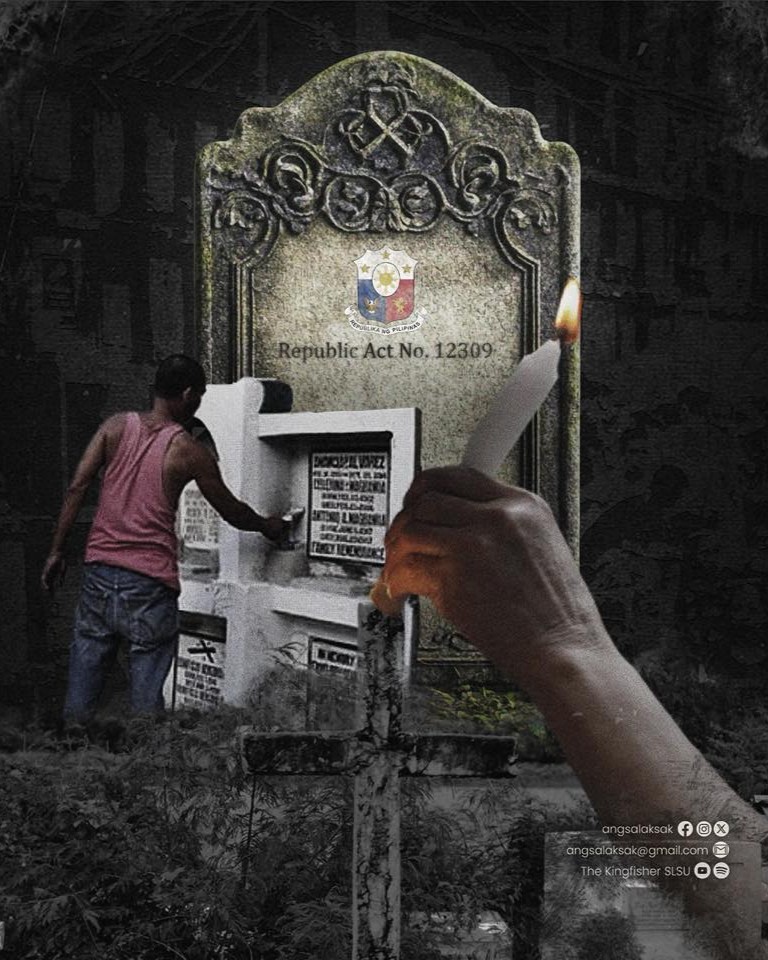
To address this, Republic Act No. 12309 or the Free Funeral Services Act like many well-intentioned policies, offers free funeral services to families deemed to be in ‘critical situations,’ including those living in poverty and affected with disasters or other emergencies, as the Department of Social Welfare and Development (DSWD) determined.
However, as someone who feels the weight of this reality for my own family, and Filipinos that witnessed the continuous shortcomings of the institutions, the law that was meant to ease agony and promise of compassion, offers little more than just a dignified farewell to the poorest citizens.
Despite its intentions, the government may only be able to provide nothing but a small piece of help in grieving, while mourning families find themselves between piles of documents, social assessments, and pleas—having to prove their loss before the state acknowledges, an unkind process to people in grief.
The institution also provides coverage merely for funeral service before the body is buried, but the expense for the grave site is not included thus, leaving the living with anxiety for the dead when there is no assurance of a plot in a public cementary which can go as high as ₱20,000.
Although other services have assistance offered for some who cannot pay for a tomb or burial plot, individuals who did not get such support remain helpless and are still forced to take loans and rent an ‘apartment tomb’ yearly to ensure that their loved ones can have a proper place to lie.
The proceedings after death for Filipinos pose grave setbacks that the law has hoped to fill, yet despite this, families that are still facing additional expenses that make the aid insufficient begs to question whether it was really signed to help, or to highlight a crucial flaw—the state cannot enforce its laws, leaving signed bills to just decompose.
The law in paper can offer much needed aid for the dead of those barely living, if only the government can ensure a whole, adequate support and funding for public funeral services, only then can the law move beyond promises to genuinely ease the burdens faced by grieving families.
Until compassion lives beyond death—this nation will never rest in peace—only in pieces.
// layout by John Saavedra
#YouthPoints #TheKingfisherSLSU
No comments yet. Be the first to comment!